
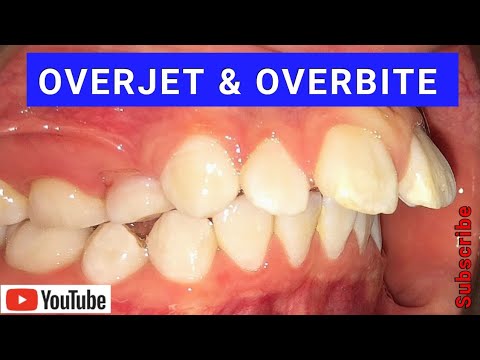
Opens on YouTube.
Key points
- An overjet is when the upper front teeth sit too far forward of the lower teeth, so they look like they stick out.
- An overbite (deep bite) is when the upper front teeth cover too much of the lower front teeth vertically.
- Both are often inherited, linked to the way the jaws grow, and can be made worse by habits such as long-term thumb sucking.
- Treatment depends on age and the cause. Growing children may be treated with a functional appliance such as a Twin Block, followed by fixed braces.
- For older teens and adults, fixed braces or, in suitable cases, clear aligners with elastics can be used.
Summary
Overjet and overbite are two of the most common reasons children are referred to an orthodontist. They often appear together but are not the same thing: an overjet is about how far forward the top teeth sit, while an overbite is about how much they overlap the bottom teeth.
In this video Dr Sarah explains the difference, why they happen and the options for correcting them, from functional braces like the Twin Block that work with a child’s growth, to fixed braces and, for some patients, aligners with elastics. A large overjet can also make the front teeth more likely to be damaged in a fall, which is one reason an early assessment is worthwhile.
Questions about this topic
What is the difference between an overjet and an overbite?
An overjet is the horizontal distance the upper front teeth sit in front of the lower ones. An overbite is the vertical overlap of the upper front teeth over the lower ones. A patient can have one, the other, or both.
When should my child see an orthodontist about sticking-out teeth?
An assessment around the age of 9 to 12, or whenever you are concerned, is sensible. Some treatments, such as functional appliances, work best while a child is still growing.
Can NHS braces be used to correct an overjet?
NHS orthodontic treatment is available for under-18s whose teeth meet the NHS eligibility criteria. Larger overjets often qualify. We can check this at an orthodontic consultation.
Can aligners correct an overjet?
In suitable cases, yes, often combined with elastics. Whether aligners or fixed braces are the better option depends on the cause and severity, which we assess at a consultation.